







Nearly every roundup of AI tools for email follow-ups opens with the same line: 80% of sales need five follow-ups, but 92% of salespeople quit after four. It's a great hook. It's also unverifiable. The figure traces back to the "National Sales Executive Association," an organization with no published study, no membership records, and no traceable history (Entrepreneur, 2017).
Here's a number that does hold up. In 2025, across 7,530,489 emails, follow-ups produced 58.6% of all replies. The first email produced 41.4% (Belkins, Sales Follow-Up Statistics in B2B, updated June 2026). Most of your replies sit behind a message you haven't sent yet.
So which tool sends it? That depends on a distinction almost every comparison skips, and it's why people buy the wrong tool. This guide covers ten tools, pricing verified in August 2026, and where each one genuinely wins.
Key Takeaways
- Follow-ups produce 58.6% of all replies; the first email produces 41.4% (Belkins, 7.5M emails, 2025).
- "Follow-up" means two different jobs: tracking promises in your own inbox, and running outreach sequences. Tools that do one rarely do the other well.
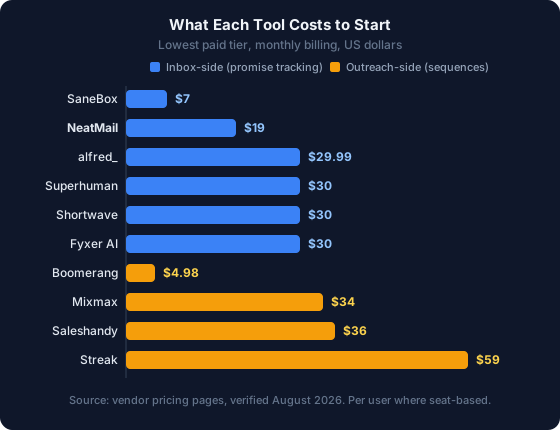
- Entry prices range from $4.98 (Boomerang) to $59 per user (Streak). Six of the ten have no free tier.
- The "92% give up after four follow-ups" statistic cited across this category has no verifiable source.
Disclosure: NeatMail is our product, and it appears on this list. Competitor figures come from public pricing and product pages verified in August 2026, not hands-on testing. Where a competitor wins, we say so.
What Does "Follow-Up" Actually Mean in 2026?
It means two jobs that share almost no engineering, which is why 58.6% of replies coming from follow-ups (Belkins, 2026) tells you nothing about which tool to buy. Buying for the wrong job is the most common mistake in this category.
Job one: promise tracking. You told a client you'd send the revised scope by Thursday. You asked your accountant a question nine days ago. Nobody is running a campaign. You made commitments inside ordinary conversations, and some of them are quietly rotting. The tool's job is to notice what you owe and what you're owed, without you tagging anything.
Job two: sequence automation. You're contacting 400 prospects who've never heard of you. Message one goes Tuesday, then two more if they don't reply. Everything stops the moment someone responds. The tool's job is scheduling, personalization at volume, and deliverability.
The tell is who initiates. Promise tracking is reactive: it watches conversations you're already in. Sequence automation is proactive: it starts conversations that don't exist yet. A CRM like Streak will never notice you promised your co-founder a deck. A promise tracker will never warm up a cold domain. Most roundups list both kinds in one table and rank them against each other, which produces a ranking nobody can act on.
The 10 Best AI Tools for Email Follow-Ups, Compared
Prices run from $4.98 a month (Boomerang) to $59 per user (Streak), a 12x spread for tools sold against the same phrase. In contrast to that range, the capability gap between them is narrower than the pricing implies. Every figure below is the lowest paid tier at monthly billing, checked against each vendor's own pricing page in August 2026. Annual discounts appear in the individual reviews.
| Tool | From | Job | Providers | Free tier |
|---|---|---|---|---|
| NeatMail | $9/mo | Promise tracking | Gmail, Outlook | No — 7-day trial |
| alfred_ | $29.99/mo | Promise tracking | Gmail, Outlook | No — 7-day trial |
| Superhuman Mail | $30/mo | Promise tracking | Gmail, Microsoft 365 | No |
| Shortwave | $30/seat | Promise tracking | Gmail only | No — 14-day trial |
| Fyxer AI | $30/user | Triage + drafting | Gmail, Outlook | No — 7-day trial |
| SaneBox | $7/mo | Reminders only | Any IMAP/Exchange | No — 14-day trial |
| Boomerang | $4.98/mo | Manual reminders | Gmail, Outlook | Yes — 10 credits/mo |
| Mixmax | $34/user | Sequences | Gmail | Yes — limited |
| Streak | $59/user | CRM sequences | Gmail only | Free email tools |
| Saleshandy | $36/mo | Cold outreach | Google, Microsoft 365 | No |
Which AI Tools Track Promises in Your Inbox?
Six do, and they cost between $7 and $30 a month to start. These watch the mail you already have, reading threads to surface what needs an answer. None of them are built to run cold campaigns, so judge them on comprehension rather than throughput.
NeatMail — best for promise tracking without changing clients
NeatMail runs from $9/month (Pro, or $7.50 billed annually) to $19/month (Max, $15.83 annually), with a 7-day trial and a 14-day money-back guarantee. It layers onto Gmail and Outlook rather than replacing them, so there's no new client to learn.
Its follow-up mechanism is a single Gmail or Outlook label called Follow up. The AI reads each thread and identifies commitments in both directions, meaning what you promised and what you're waiting on, then surfaces them under that one label inside the client you already use. Pro includes 50 follow-ups a month; Max is unlimited. It also drafts replies in your tone (100/month on Pro, unlimited on Max), auto-labels mail in real time, and handles bulk unsubscribe and storage cleanup.
Our design note: We shipped promise tracking as one label, not two lists. An earlier build separated "waiting on you" from "waiting on them," and it tested badly. People had to remember which list to open, so they opened neither. One label that already lives in the client you check anyway gets read. A second dashboard doesn't.
NeatMail is also source-available under the Elastic License 2.0 and self-hostable, so you can audit the code or run it on your own infrastructure, free, if you host it yourself. Where it loses: no meeting notetaker, no shared inbox, and no cold-outreach sequencing. If you need to contact 400 strangers on a schedule, this is the wrong half of the list. Start a 7-day free trial if promise tracking is the job.
alfred_ — closest competitor, higher price
alfred_ costs $29.99/month for individuals and $34.99 per seat for Teams with a two-seat minimum, after a 7-day free trial (alfred_, 2026). It works with Gmail and Outlook and integrates Google Calendar.
Its approach is the closest thing to NeatMail's on this list. The AI detects which conversations need a follow-up, drafts the message in your writing style, and uses your calendar to time it. If you want promise tracking bundled with calendar-aware scheduling and price isn't a factor, it's a legitimate pick. Where it loses: by comparison it costs 58% more than NeatMail Pro, it's closed-source with no self-hosting option, and it publishes no stated limits on follow-ups or AI drafts, so you're buying without knowing the ceiling.
Superhuman Mail — best if speed matters more than price
Superhuman charges $30/month for Starter ($25 annually) and $40/month for Business ($33 annually), with no free tier (Superhuman, 2026). Grammarly acquired the company in July 2025 (TechCrunch, 2025).
Follow-ups run through read receipts, a Recent Opens feed, and reminders that resurface a thread if nobody replies. Its Auto Drafts feature is genuinely strong: in beta, 40% of auto-drafts were sent within a day, and 60% of those went out unedited (TechCrunch, 2026). Where it loses: it replaces your email client, which means an hour of setup and a couple of weeks learning 100+ keyboard shortcuts. Auto Drafts also sit on the $40 tier. Full breakdown in our NeatMail vs Superhuman comparison.
Shortwave — best AI search, Gmail only
Shortwave starts at $30 per seat per month (Business), rising to $45 (Premier) and $120 (Max), after a 14-day trial (Shortwave, 2026). Founded by ex-Google engineers as a successor to Google Inbox, its semantic AI search across years of history is the best in this group.
Where it loses on follow-ups specifically: it doesn't clearly advertise follow-up or promise tracking as a feature. Its strengths are search, summarization, and agents. It also supports Gmail and Google Workspace only, with no Outlook, Microsoft 365, or IMAP. If you're on Outlook, it isn't an option at all. See the NeatMail vs Shortwave comparison for the full picture.
Fyxer AI — best if meetings matter as much as email
Fyxer starts at $30 per user per month ($22.50 annually) and rises to $50 for its Professional plan with multiple inboxes (Fyxer, 2026). It auto-sorts Gmail and Outlook into categories like To Respond and FYI, drafts tone-matched replies, and holds SOC 2 Type II, ISO 27001, HIPAA, and GDPR compliance.
Its standout is a meeting notetaker, where an AI bot joins Google Meet and Teams calls, captures action items, and drafts the follow-up email afterward. If half your commitments are made out loud rather than in writing, that's a real advantage no other tool here matches. Where it loses: Fyxer doesn't advertise inbox-side follow-up tracking at all, so promises made in email aren't covered. Details in the NeatMail vs Fyxer comparison.
SaneBox — cheapest reminders, widest provider support
SaneBox runs $7/month (Snack), $12 (Lunch), and $36 (Dinner) after a 14-day trial (SaneBox, 2026). Its SaneReminders feature nudges you when an email goes unanswered, and it works with any IMAP or Exchange account, including iCloud, Fastmail, and Proton.
The critical caveat nobody mentions: SaneBox analyzes only metadata, meaning sender, subject, and your interaction history, and deliberately never stores message bodies. That's excellent for privacy, and in practice a hard ceiling on follow-ups. A tool that can't read the body can't know you promised to send the contract Thursday. It can only tell you a thread went quiet. Where it wins: provider coverage and metadata-only privacy. Where it loses: it never drafts email, and its follow-ups are timer-based rather than promise-based. See the NeatMail vs SaneBox comparison.
Which AI Tools Automate Follow-Up Sequences?
Four do, priced from $4.98 to $59 per user per month, and all four are built for outreach rather than your existing inbox. Judge them on deliverability and scheduling. None of them will notice a promise you made in a thread.
Boomerang — cheapest way to never forget a thread
Boomerang has a genuine free tier (10 message credits a month), then Personal at $4.98/month, Pro at $14.98, and Premium at $49.98. It works in Gmail and Outlook, and the core feature is manual and reliable: return this to my inbox if nobody replies in X days. Respondable scores your draft for likely response rate before you send.
Where it loses: the detection is manual. In practice, you have to remember to set the boomerang on the message that matters, which is exactly the step people skip when they're busy. No AI reads your threads to catch the ones you forgot.
Mixmax — sequences plus scheduling for Gmail teams
Mixmax has a free plan (50 sequence recipients, 20 tracked emails a month), then Inbox Copilot at $34/user/month ($29 annually), Engagement Copilot at $65 ($49 annually), and the full Suite at $105 ($89 annually) (Mixmax, 2026). Engagement Copilot adds an AI sequence builder and personalization at volume.
Where it loses: it's Gmail-centric and priced for sales teams. For a solo professional tracking personal commitments, you're paying for a sequencing engine you'll never run. Teams already running Gmail-based outbound get more from it, particularly where scheduling and sequencing sit in the same workflow.
Streak — sequences inside a CRM pipeline
Streak is a Gmail-based CRM: Pro at $59/user/month ($49 annually), Pro+ at $89 ($69), and Enterprise at $159 ($129), with free email power tools including tracking and 50 mail merges a day. AI credits are allocated per tier, from 20 per user per month on Pro up to 500 on Enterprise.
Where it loses: it's the most expensive entry point on this list, it's Gmail only, and it's a CRM first. If you want pipeline stages, it's excellent. If you want your inbox to notice an unanswered promise, you're buying a database. The AI credit allocation is worth checking before you commit, since 20 credits a month on Pro runs out quickly at any real volume.
Saleshandy — highest volume, cold outreach only
Saleshandy's Outreach plans run $36/month for Starter (2,000 active prospects, 6,000 emails/month), $99 for Pro, $199 for Scale, and $299 for Scale Plus, with unlimited email accounts on every plan and automated follow-ups throughout (Saleshandy, 2026). It connects Google Workspace, Microsoft 365, and Azure.
Where it loses: this is cold outreach infrastructure. It has no concept of your personal commitments and isn't trying to. Note also that the "$25 to $209" range cited for Saleshandy in older roundups is out of date. The current Starter plan is $36 monthly, or $300 billed annually.
Is the "92% Give Up After Four Follow-Ups" Statistic True?
No. There's no verifiable source for it, and in 2017 Entrepreneur described the claim as "an amalgam of two cherry-picked numbers" repackaged into a line that trips neatly off the tongue (Entrepreneur, 2017). Search this category and you'll meet it in nearly every article.
Both halves of the claim, that 80% of sales require five follow-ups and 92% of salespeople give up before the fifth, are attributed to the National Sales Executive Association. That association has no verifiable published research and no traceable institutional history. The figure has been repeated for over a decade because it's memorable, not because anyone checked it.
Why does this matter for choosing a tool? Because the fake statistic implies persistence is the whole problem. Send more, win more. Tools get sold on that premise. The verifiable data says something narrower and more useful.
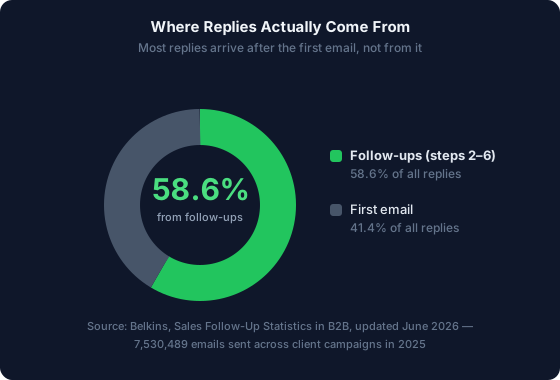
Two datasets with published methodology beat the myth. In 2025, Belkins analyzed 7,530,489 emails sent across client campaigns and found follow-ups produced 58.6% of all replies. Separately, Backlinko's analysis of 12 million outreach emails found that sending one additional follow-up boosts replies by 65.8%. That study was last updated in April 2019 (Backlinko, 2019), so treat it as directional rather than current.
How Many Follow-Ups Should You Actually Send?
Three to five steps total, then stop. In 2025, Belkins found the practical sweet spot for B2B sequences is 3 to 5 steps, with returns dropping sharply after step five (Belkins, 2026). Per-step reply rates fall from 0.59% on the first email to 0.28% by step six.
The more interesting finding is about meetings rather than replies. Steps one and two together produced 46.4% of all email-sourced meetings. Step three alone produced 35.6%, and steps three through five together produced 53.5%, a majority. The third message does disproportionate work, which means anyone who stops after two is leaving most of their meetings on the table.
For personal and professional email, the arithmetic is simpler. You usually need one well-timed nudge, not a sequence. Our guide to handling email follow-ups covers the timing in depth, and if you just need the words, the follow-up email generator and gentle reminder generator will draft one free.
Which Follow-Up Tool Should You Choose?
Answer one question, and the $4.98-to-$59 price range collapses into two or three real candidates: are you chasing people who know you, or people who don't?
People who know you (promise tracking). You need something that reads threads and surfaces commitments without being told. On Gmail or Outlook, NeatMail at $9/month or alfred_ at $29.99. If you'd switch clients for speed, Superhuman at $30. If you're Gmail-only and want elite search alongside it, Shortwave at $30/seat. On an unusual IMAP provider where none of those work, SaneBox at $7, accepting that it only knows a thread went quiet, not what you promised in it.
People who don't know you (sequences). Budget-conscious and low volume: Boomerang at $4.98. Gmail team with scheduling needs: Mixmax at $34/user. Pipeline management: Streak at $59/user. Serious cold outreach volume: Saleshandy at $36.
Both. Run one from each column. They don't conflict, because they touch different mail. Don't expect either to cover the other's job.
Our take: Most people asking for a "follow-up tool" want job one and get sold job two. If you've ever bought a sequencing tool and abandoned it in a month, this is why. It was waiting for you to build a campaign, and you just wanted your inbox to remember what you promised.
Which Tools Did We Leave Off This List?
Two, for opposite reasons. Notion Mail shuts down on September 22, 2026, and users must export drafts, scheduled emails, snippets, and auto-label rules before September 21 (Notion, 2026). It launched in April 2025 and lasted roughly 17 months. We've written a migration guide for Notion Mail users. Its short life is also an argument for keeping your AI layer separate from your client. A layer survives a client's sunset; a client doesn't.
FollowUp.cc appears in older roundups, but its current operating status is unclear from public sources. Its site still carries a 2026 copyright, while at least one third-party review describes the service as discontinued. We've left it out rather than publish a price we can't verify.
Frequently Asked Questions
What is the best AI tool for email follow-ups?
It depends on which job you mean. For tracking promises inside your own inbox, NeatMail ($9/month) and alfred_ ($29.99/month) both read threads and surface commitments automatically. For automated outreach sequences to cold prospects, Saleshandy ($36/month) or Mixmax ($34/user) fit better. Buying across that line is the most common mistake in this category.
Can AI detect which emails need a follow-up automatically?
Yes, if the tool reads message content. NeatMail, alfred_, and Superhuman all analyze thread context to flag unanswered messages and unmet commitments. Tools like SaneBox and Boomerang cannot. SaneBox reads only metadata such as sender and subject, and Boomerang requires you to set each reminder manually before sending.
How many follow-up emails should I send?
Three to five total steps for B2B outreach. Belkins' analysis of 7,530,489 emails found returns drop sharply after step five, with per-step reply rates falling from 0.59% on the first email to 0.28% by the sixth (Belkins, 2026). For personal or client email, one well-timed nudge is usually enough. A sequence reads as pressure.
Is the "92% of salespeople give up after four follow-ups" statistic true?
There's no evidence for it. The figure is attributed to the National Sales Executive Association, which has no verifiable published study or institutional record, and analysts have described the claim as two cherry-picked numbers merged into a memorable line (Entrepreneur, 2017). Use the Belkins 2025 dataset instead: follow-ups produced 58.6% of all replies.
Which follow-up tools work with Outlook?
NeatMail, alfred_, Superhuman Mail, Fyxer AI, Boomerang, and Saleshandy support Outlook or Microsoft 365. Shortwave, Mixmax, and Streak are Gmail-only. SaneBox has the widest reach of all, working with any IMAP or Exchange account, including iCloud, Fastmail, and Proton.
Are there free AI tools for email follow-ups?
Genuinely free tiers are rare. Boomerang offers 10 message credits a month, Mixmax caps its free plan at 50 sequence recipients and 20 tracked emails, and Streak gives away email tracking and mail merge. Most AI-native tools, including NeatMail, alfred_, Superhuman, Shortwave, and Fyxer, offer trials rather than free plans. NeatMail is also free if you self-host it under the Elastic License 2.0.
Do I have to switch email clients to get AI follow-ups?
Only for some. Superhuman and Shortwave replace your client with their own app. NeatMail, alfred_, Fyxer, SaneBox, and Boomerang layer onto the Gmail or Outlook you already use, so labels and drafts appear in your existing inbox with nothing new to learn.
Conclusion
The category splits cleanly once you name the split. Promise tracking watches conversations you're already in; sequence automation starts ones that don't exist yet. Almost every buying mistake here comes from a comparison table that pretends those are the same product.
| Category | Winner |
|---|---|
| Promise tracking, best value | NeatMail ($9/mo) |
| Promise tracking, premium | alfred_ ($29.99/mo) |
| Speed and keyboard control | Superhuman |
| AI search depth | Shortwave |
| Meeting follow-ups | Fyxer AI |
| Provider coverage | SaneBox (any IMAP) |
| Cheapest reminders | Boomerang ($4.98/mo) |
| Cold outreach at volume | Saleshandy |
| Transparency and self-hosting | NeatMail |
If the mail you're chasing is from people who already know you, start with the tool that reads your threads and needs no campaign built first. Try NeatMail free for 7 days. For the wider system around it, see our complete guide to email management in 2026, or read how the drafting works under the hood in our context pipeline deep dive.
Sources
All pricing pages were checked directly on the dates below. Where a vendor changes pricing after publication, the figures here are what that page showed on the retrieval date.
- Belkins, Sales Follow-Up Statistics in B2B, updated June 2026, retrieved 2026-08-18, https://belkins.io/blog/sales-follow-up-statistics
- Backlinko, Email Outreach Study, last updated April 2019, retrieved 2026-08-18, https://backlinko.com/email-outreach-study
- Entrepreneur, Sales Statistics: Focus On Those That Matter, April 2017, retrieved 2026-08-18, https://mena.entrepreneur.com/growth-strategies/sales-statistics-focus-on-those-that-matter/293269
- TechCrunch, Grammarly acquires AI email client Superhuman, July 2025, retrieved 2026-08-18, https://techcrunch.com/2025/07/01/grammarly-acquires-ai-email-client-superhuman/
- TechCrunch, Superhuman's new Auto Draft feature almost makes me like AI replies, July 2026, retrieved 2026-08-18, https://techcrunch.com/2026/07/14/superhumans-new-auto-draft-feature-almost-makes-me-like-ai-replies/
- alfred_, Pricing, retrieved 2026-08-18, https://get-alfred.ai/pricing
- Superhuman, Pricing, retrieved 2026-08-18, https://superhuman.com
- Shortwave, Pricing, retrieved 2026-08-18, https://www.shortwave.com/pricing/
- Fyxer, Pricing, retrieved 2026-08-18, https://www.fyxer.com/pricing
- SaneBox, Pricing, retrieved 2026-08-18, https://www.sanebox.com/pricing
- Mixmax, Pricing, retrieved 2026-08-18, https://www.mixmax.com/pricing
- Saleshandy, Plans and Pricing, retrieved 2026-08-18, https://www.saleshandy.com/pricing/
- Streak, Pricing, retrieved 2026-08-18, https://www.streak.com/pricing
- Boomerang, Pricing, retrieved 2026-08-18, https://www.boomeranggmail.com
- Notion, Notion Mail inbox is going away: what to do next, 2026, retrieved 2026-08-18, https://www.notion.com/help/notion-mail-inbox-is-going-away-what-to-do-next